
The emotion system is comprised of four primary emotions:
- Anger
- Sad
- Afraid
- Happy
There are other secondary-specific emotions, such as surprise, disgust, and shame, but these secondary-specific emotions are more restricted in scope and have only limited impact on day-to-day parenting. For 99% of parenting we are concerned with the four primary emotions of anger, sad, afraid, and happy (pleasure).
Each of these primary emotions has three functions:
Signal Function:
Each emotion provides certain information about the world which can be used to guide our response to the situation.
Social Function:
Each emotion has a different impact on other people when we communicate the emotion into the social field.
Brain Function:
Each emotion has a differing impact on the organizational state of the brain. For example the emotion of anxiety-fear turns all of the brain systems ON, whereas the emotion of sadness turns all of the brain systems OFF.
Each of the primary emotions will be described more fully in separate essays for each primary emotion and each emotion-specific essay will examine the information provided by each emotion (its Signal Function), the social impact of each emotion (its Social Function), and how each emotion prepares the brain for a different type of task (its Brain Function). The current essay will provide a broad introductory overview of the emotion system.
Communication
Emotions are a “regulatory system.” Specific emotion emerge in response to the combined state-of-the-world and the needs-of-the-organism, and the emotion that emerges provides important functions for the organism in dealing with the current state-of-the-world and needs-of-the-organism.
For example, in response a perceived threat the emotion of anxiety-fear may activate (Signal Function) which prepares the organism with a heightened level of arousal (Brain Function) necessary for alert responding and possible flight or for a possible social display of submissiveness (Social Function) to turn off the threat posed by the other person.
If fleeing from the threat or presenting a submissive display to the threat is determined to be problematic (either from features of the current situation or from prior past experience in coping with threat), then the emotion of anger may emerge to prepare the organism for a fight response in order to defend against the perceived threat. The emergence of anger communicates that a threat exists that must be defended against (Signal Function), and may intimidate the threat into withdrawing (Social Function), and involves a brain response (Brain Function) of increasing the power throughout the physical system and turning ON all brain systems EXCEPT the two relationship systems of attachment bonding (I no longer care about you) and psychological connection (I no longer feel your pain), which are instead turned OFF by the emotion of anger (along with the two “weak” and vulnerable emotions of anxiety and sadness which are also turned off by the emotion of anger). Anger infuses the organism with power to defend against a perceived threat.
All of this will be explained in the individual emotion essays that examine each emotion separately.
The important point to understand is that emotions communicate the underlying functioning of the brain. Emotions are one of the primary sources for our understanding what is happening in the underlying brain systems of the child. Once we understand what each emotion is communicating about the underlying brain systems, and how to address the needs of these underlying brain systems to turn off the emotion, then we have our guide as to how to respond in a productive way to restore a relaxed, calm, and cooperative child (i.e., a happy-pleasure brain state).
Developmentally supportive parenting is about relationship and communication, not about behavior. Behavior is a communication, behavior is a symptom. The brain is the cause.
Emotional Inhibition
Another important thing to realize about the emotion system is that there are two main inhibitory networks within the brain that TURN OFF the intensity of the emotion. These inhibitory networks in the brain suppress the experienced intensity of the emotion, turning rage into annoyance, sorrow into sadness, and terror into anxiety.
The first and primary inhibitory network is through the Language and Communication networks of the brain. When we bring emotions into and  through the language and communication system, an inhibitory network is activated from the communication networks back to the emotional system that suppresses the intensity of the emotions.
In the scientific literature, this is referred to as a change in the emotional quality from “catastrophic emotions” that are explosive and expressive, to “emotional signaling” in which the emotions now carry a communicative value. This process of transforming the emotional system from catastrophic emotional displays to emotional signaling will be described more fully in essays on the relationship system of psychological connection – called “intersubjectivity” in the scientific literature.
As just a little communication tip, if you want to reduce the intensity of someone else’s anger toward you all you need to do is bring their anger into their language and communication networks by listening to them. Encouraging the other person to tell us about their anger by our listening will bring their emotion, their anger, into and through their language and communication networks which will activate the inhibitory networks back to their emotional system and reduce the intensity of their emotion – of their anger. Anger in another person is reduced by our listening and empathy.
Too often, however, we respond to the other person’s anger (their attack, criticism, and threat) by defending and counter-arguing as to why the other person shouldn’t be angry with us. This stunts the other person’s ability to bring their emotion into their language and communication networks, leading the other person to try with even greater volume and insistence to communicate their anger to us.
Listening – bringing emotion into the language and communication networks – reduces the intensity of the other person’s emotions, whether that emotion is anger, or anxiety, or sadness.
The second inhibitory network is from the Executive Function System of thinking. When we bring the communication of emotions into and through the Executive 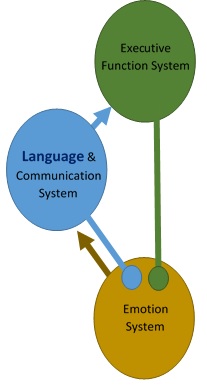 Function System of language (“use your words”) a second inhibitory network from out of the Executive Function System also then acts to quiet and dampen the intensity of the emotional experience.
Emotions and thinking cross-inhibit each other. When we think we don’t feel, and when we feel we don’t think. I’m sure we are all familiar with the type of person who is incredibly rational and thinking oriented, and how this hyper-rational person’s emotions are over-controlled and suppressed. Then there is the other extreme of the highly emotional person whose thinking and rational judgement are impaired by his or her over-emotionality. What we want in healthy development is a balance of both thinking and feeling, so that we have access to both sets of information.
Emotions and Motivation
The emotion system also plays a role in one of the three motivational networks for active exploratory learning (the “Play” motivational network). The exploratory learning motivational network is guided by the principle of “seek pleasure – avoid pain” and is located in the sensory-motor and emotional networks of pain and pleasure. The active exploratory learning motivational system will be described separately in its own essay
Emotions and the Sensory-Motor System
The emotional system is embedded within the sensory-motor networks. Problems in sensory-motor regulation and integration can lead to problems in emotional regulation (a particular problem during early childhood). We can also create within ourselves low-levels of any particular emotion by just physically acting as if we had the emotion (this is how actors create their portrayals, they physically act as if they had an emotion, which generates a seed of the emotional experience, which the actor then expands and conveys into his or her performance).
One of the most useful emotions for parents to generate in this way is the emotion of happy-pleasure. This can easily be accomplished by simply smiling. I don’t care if you feel happy or not. Just smile anyway. The act of smiling itself will generate a low-level experience of the happy-pleasure emotion (a half-point on a 1-10 point scale).
Because the happy-pleasure emotion blends with all other emotions (which will be discussed in a separate essay), generating a low-level happy-pleasure emotion burst by simply smiling – even if you don’t feel like smiling – especially if you don’t feel like smiling – can soften and transform the experience of the other emotions.
For example, adding a low-level happy to the emotion of anxiety by simply smiling will transform anxiety into excitement (“woo-hoo, it’s kind of scary but it’s also fun”).
Adding a low-level happy to the emotion of anger is probably the most productive thing to do. Smiling when you’re angry – even though you don’t feel like smiling – will add a low-level happy-pleasure to the anger that relaxes the anger and reduces its intensity. The emotion of happy-pleasure is “no worries.” Adding the emotion of “no-worries” to anger can be extremely productive in almost every circumstance. Try it. Smile – even though you don’t feel like it – smile anyway.
The emotion of happy-pleasure is also the social bonding emotion (Social Function), so that when we smile we increase bonding with other people. This is especially valuable in parenting where the quality of the parent-child bond is so critical. Smile. A lot. More.
With the brain, we build what we use. If you start using the brain networks for generating low-level happy-pleasure by smiling – even if you don’t feel like it – you will be “canalizing” the channels in your brain for creating happy-pleasure. Do it once, do it twice, do it 10,000 times and you will have developed a positive happy-pleasure channel in your brain that will improve the quality of your life immeasurable. You will feel happier, and because the happy-pleasure emotion is the social bonding emotion (Social Function) people will like you better, you’ll have more friends, and you will be loved even more than you are now.
Smile. Practice it. A lot.
Understanding Emotions
In developmentally supportive parenting we will be using the child’s emotions as a window into the underlying functioning of the various brain systems of the child, and we will be using certain relationship-based and communication-based interventions to bring the child’s emotional expressions into the Language and Communication System.
The key to this will be understanding the function of each of the four primary emotions – anger, sadness, afraid, and happy. We well discuss each of these primary emotions in a separate essay for each emotion.
Craig Childress, Psy.D.
Clinical Psychologist, PSY 18857
 Developmental Parenting: An Integrated Approach to Parenting